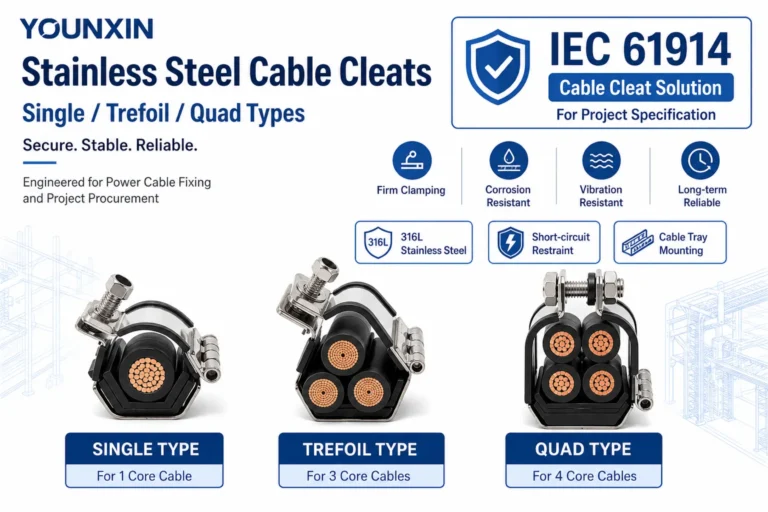
Choose the cleat formation from the cable layout first, then verify diameter, restraint performance and mounting conditions. A single cleat holds one cable, a trefoil cleat holds three single-core cables in a triangular formation, and a quad cleat holds a drawing-defined group of four cables.
For substations, data centers, industrial plants and renewable energy cable routes, the name or stainless steel grade alone is not enough to select a model. This guide explains what to compare and what to send for an IEC 61914 cable cleat inquiry.
Single vs Trefoil vs Quad: Quick Comparison
| Cleat type | Cable formation | What to confirm | Key selection point |
|---|---|---|---|
| Single | One cable per cleat; individual or flat routes as designed. | Actual cable outside diameter and spacing between adjacent cables. | Check the complete route arrangement, not only the fit around one cable. |
| Trefoil | Three single-core cables in a triangular group. | Each cable's outside diameter, formation and mounting dimensions. | Match the specified model and installation to applicable test evidence. |
| Quad | Four cables grouped in the positions shown on the drawing. | All four diameters, cable positions and center-to-center distances. | Confirm evidence applicable to the four-cable arrangement; do not assume trefoil results transfer directly. |
Use cable outside diameter in millimeters, not conductor cross-section in mm², to check the cleat's fit. Cables with the same conductor size can have different overall diameters because of their insulation, screen, armor and outer sheath.
What IEC 61914 Means for Selection
IEC 61914:2021 covers requirements and tests for cable cleats and intermediate restraints in electrical installations. Resistance to electromechanical forces is addressed where declared. The standard also considers cleats that rely on a manufacturer-specified mounting surface for axial or lateral retention.
For procurement, request the standard edition and the documentation applicable to the proposed model. An IEC 61914 reference in a product title is not a model-specific short-circuit rating. Where short-circuit restraint is required, check the report and installation instructions together.
- Model and assembly: cleat size, material, liner, closure hardware and any intermediate restraints.
- Tested installation: cable diameter and formation, cleat spacing, support structure and fixing arrangement.
- Fault duty: declared peak current, RMS current and duration, as applicable to the report and project specification.
- Other project requirements: axial load for vertical routes, environmental conditions and any specified fire or smoke performance.
Keep the report number and model reference in the purchase specification so substitutions can be reviewed against the same requirements.
Test Reports Available on Request
Younxin holds test reports for selected cable cleat models. You can request the applicable documentation when reviewing a model for your project.
- Short-circuit restraint: reports for YY-T2405 and YY-Q3340.
- UV-aging appearance: report for FF-T3035.
- Needle-flame: report for YY-T2405.
Each report applies to the sample model and configuration tested. Confirm the selected model, cable arrangement and installation conditions when requesting documentation.
Single Cable Cleats
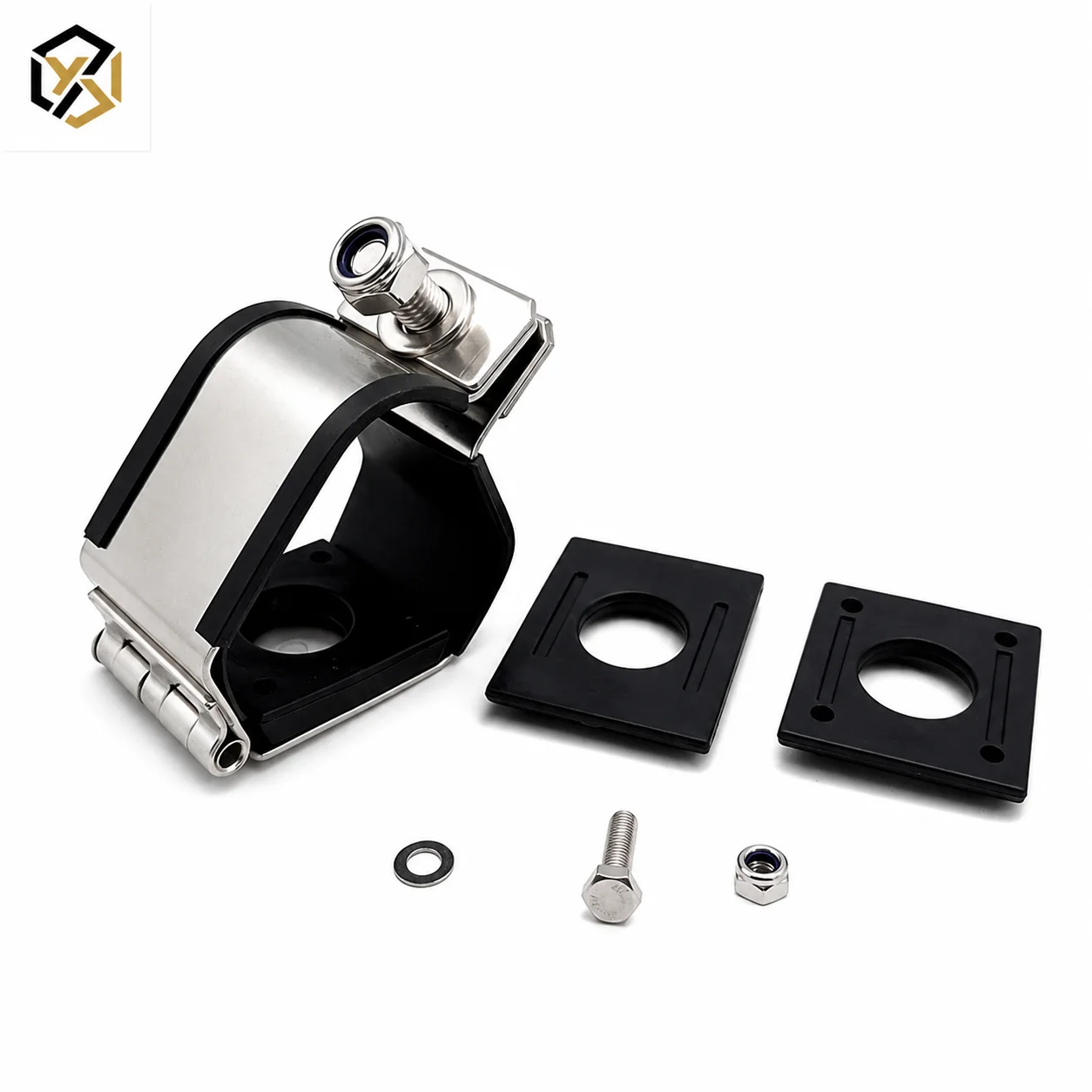
Single cable cleats secure one cable at each fixing point. They suit routes where the installation drawing requires cables to be held individually, including flat or spaced arrangements on trays, ladders or brackets.
Check the actual cable diameter, the model's clamping range, the liner and the mounting-hole dimensions. For single-core AC circuits, retain the cable positions and spacing specified by the electrical design; separate cleats do not remove the need to assess forces between cables.
Trefoil Cable Cleats
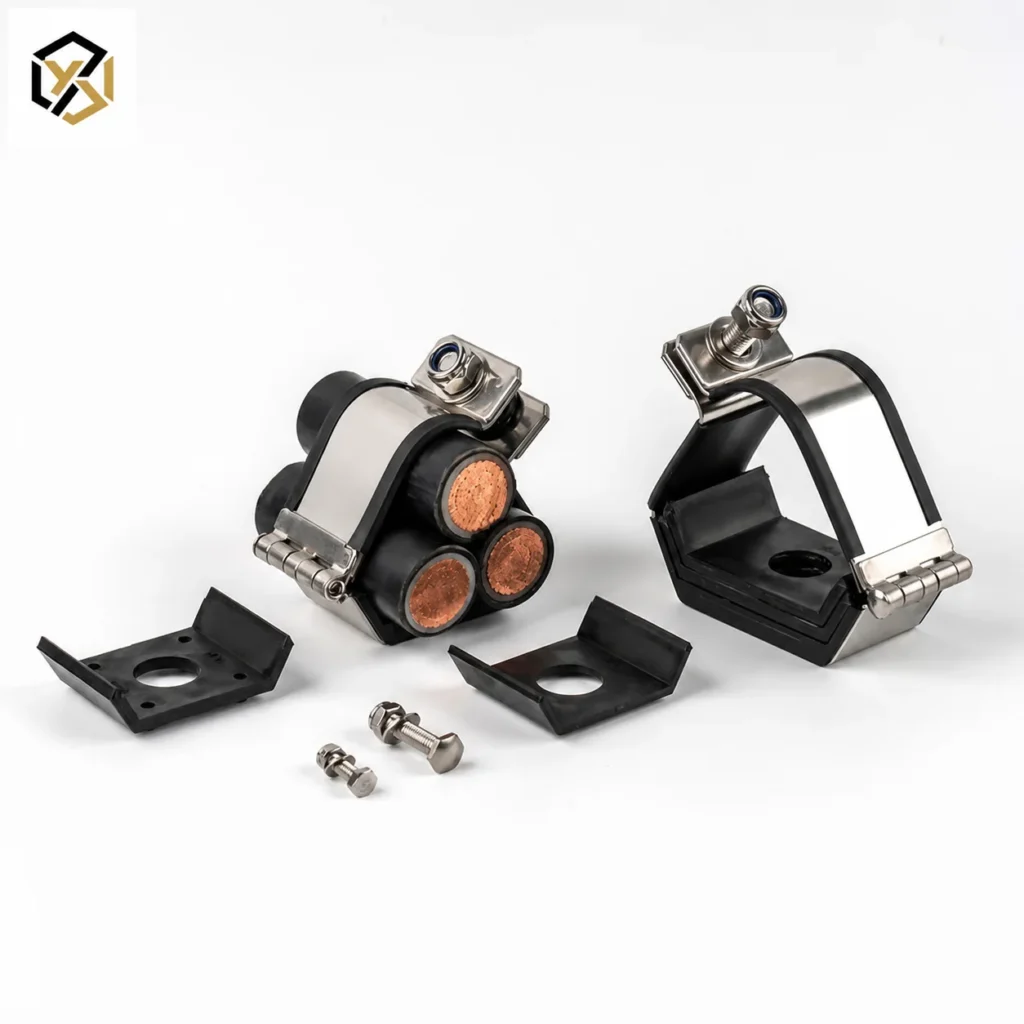
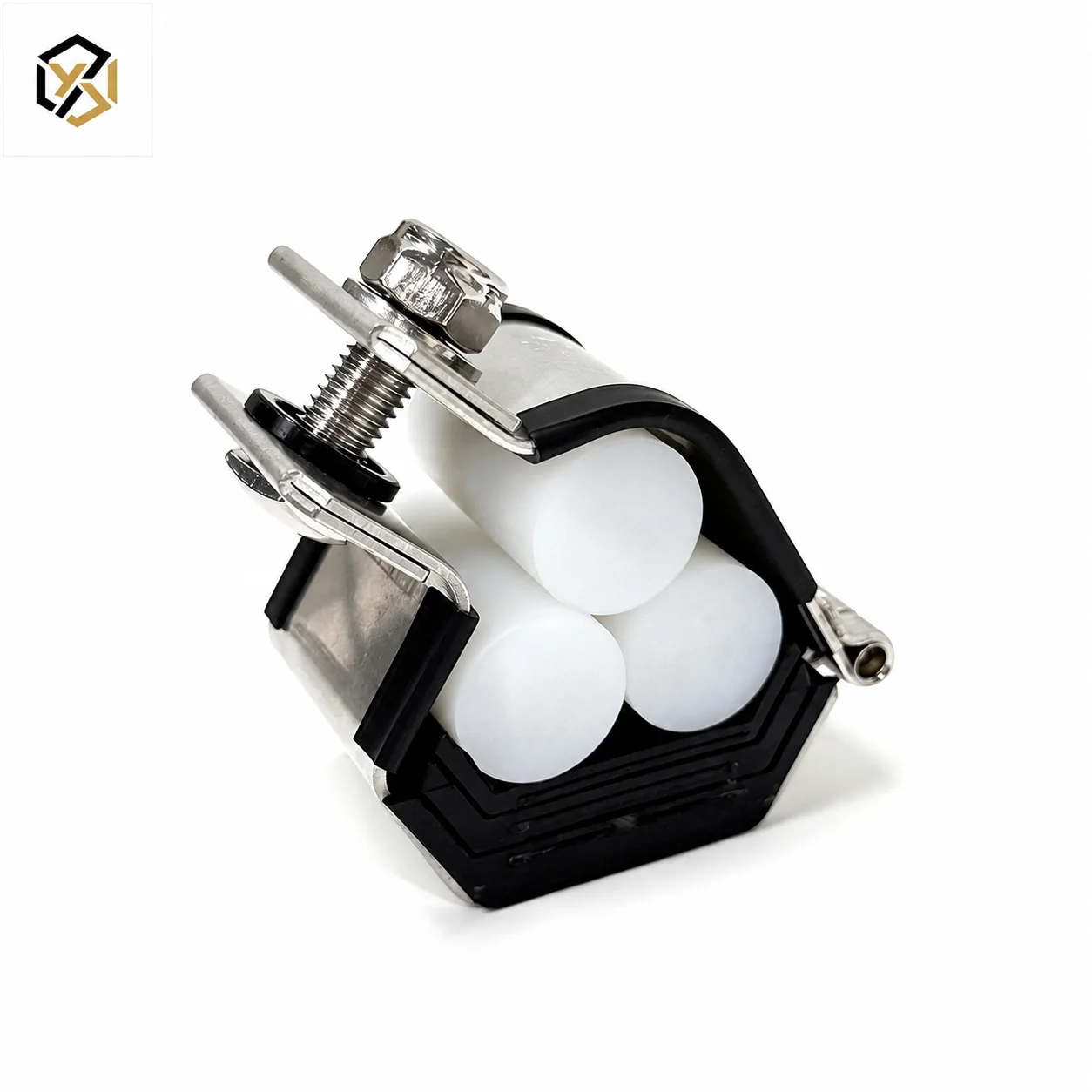
Trefoil cable cleats hold three single-core cables in a triangular formation. They are used where that formation is specified for the circuit, including many substation, industrial and data center power routes.
Provide the outside diameter of each cable and the layout drawing. Confirm how the selected cleat maintains the formation, which liners and fixings are included, and whether any intermediate restraints are required. A cleat that fits the cables still needs performance evidence appropriate to the installation.
Quad Cable Cleats
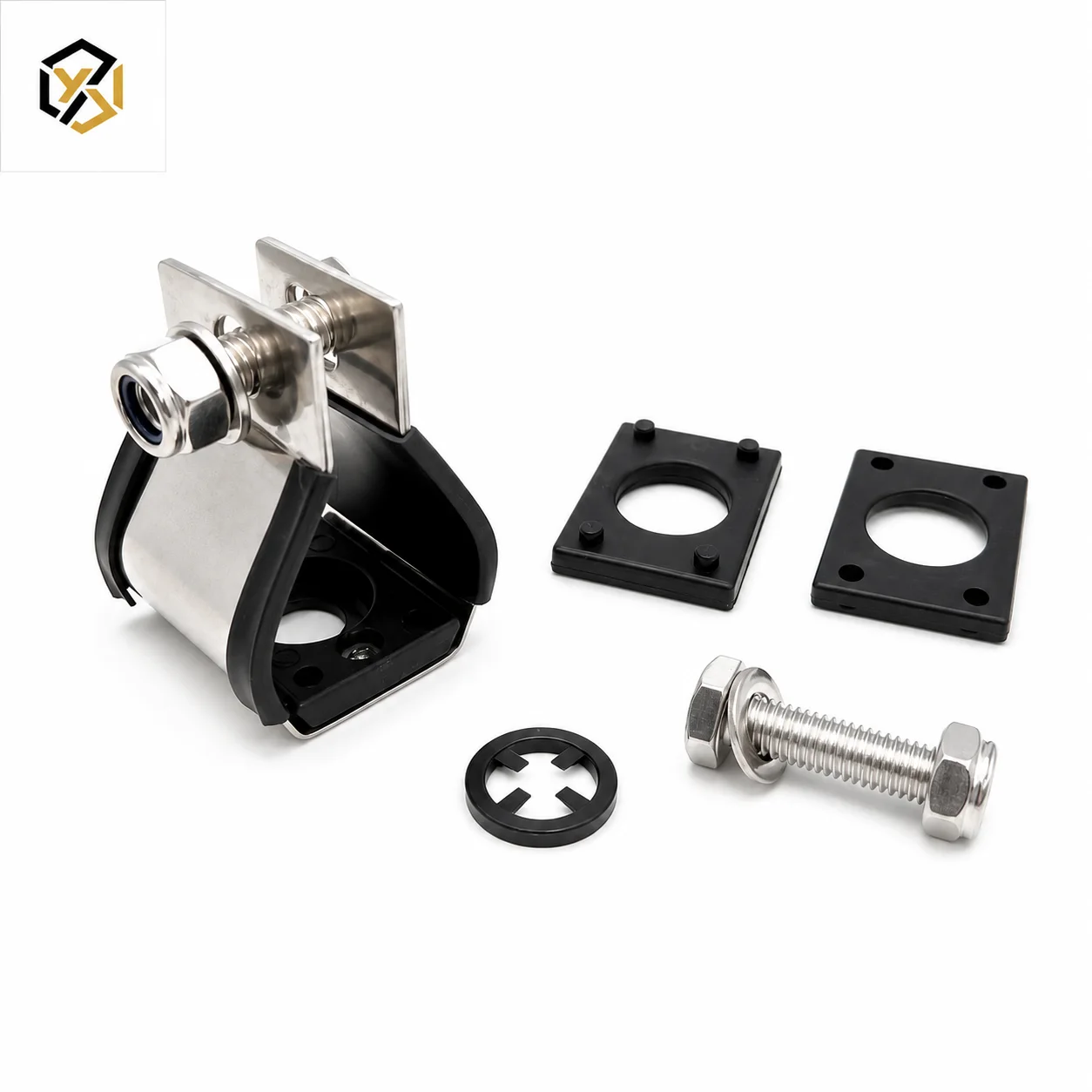
Quad cable cleats hold four cables in a grouped formation. The four-cable layout must come from the project drawing: do not assume that every quad installation has the same cable positions, conductor functions or cable diameters.
Send a cross-section drawing showing all four cables, their diameters and center-to-center distances. If a neutral or another cable has a different diameter, state that explicitly. Ask the supplier to identify the model and explain which test evidence and engineering assessment apply to the proposed quad configuration.
Do not select a quad assembly from a trefoil photograph or transfer a published trefoil short-circuit value to a quad arrangement without a documented assessment.
Cleat Spacing and Mounting Checks
There is no single spacing value suitable for every cable route. The spacing along the route must be assessed with the cable formation, fault duty, selected cleat and supporting structure. Spacing between adjacent cables is a separate dimension and should also appear on the drawing.
- Confirm the fault data. Record peak short-circuit current in kA, RMS short-circuit current in kA and fault duration in seconds separately. If only one current value is available, identify what it represents and request the remaining design data.
- Check the proposed configuration. Compare the cable diameter, formation, cleat pitch and intermediate restraints with the report and manufacturer's instructions.
- Check the support and fixings. Verify tray or ladder dimensions, mounting holes, fasteners, liner and installation torque. Vertical routes also need the relevant cable-weight and axial-retention assessment.
- Resolve differences before ordering. Changes to diameter, spacing, formation or support need a documented review by the responsible project engineer and supplier.
304, 316 or 316L Stainless Steel?
Select material from the site's exposure and the project specification. Consider moisture, salt, chemicals, temperature and contact with dissimilar metals, together with the fasteners and liners.
- 304: often considered for less aggressive environments, subject to the specified corrosion requirements.
- 316: a molybdenum-containing grade considered where greater corrosion resistance is needed. Suitability still depends on the actual exposure.
- 316L: the low-carbon form of 316. Its lower carbon content helps reduce susceptibility to intergranular corrosion after welding; it is not a blanket guarantee of better performance than 316 in every environment.
The grade designation alone does not establish the cleat's short-circuit performance, outdoor life or fire classification. Check material documentation, the complete assembly and any specified UV, flame, smoke or halogen requirements for non-metallic parts. Outokumpu's 316 and 316L grade guidance explains the material distinction.
What to Send for a Cable Cleat Quote
Start with cable outside diameter, cable arrangement and quantity. Add a drawing or cable schedule if available. You can paste the checklist below into the Requirements field of our inquiry form.
Cable arrangement: Single / trefoil / quad / drawing reference
Cable outside diameter: ___ mm for each cable
Quantity: ___ cleats, or route schedule for quantity review
Peak short-circuit current: ___ kA peak
RMS short-circuit current: ___ kA RMS
Fault duration: ___ seconds
Proposed cleat spacing: ___ mm along the route / to be reviewed
Support and orientation: Tray / ladder / bracket; horizontal / vertical
Environment and material: ___
Documents required: Drawing / datasheet / applicable test report / material document
Delivery destination and target date: ___
If a value is unknown, mark it as “to be confirmed.” The project engineer should confirm the installation design and fault duty before a performance specification is finalized.
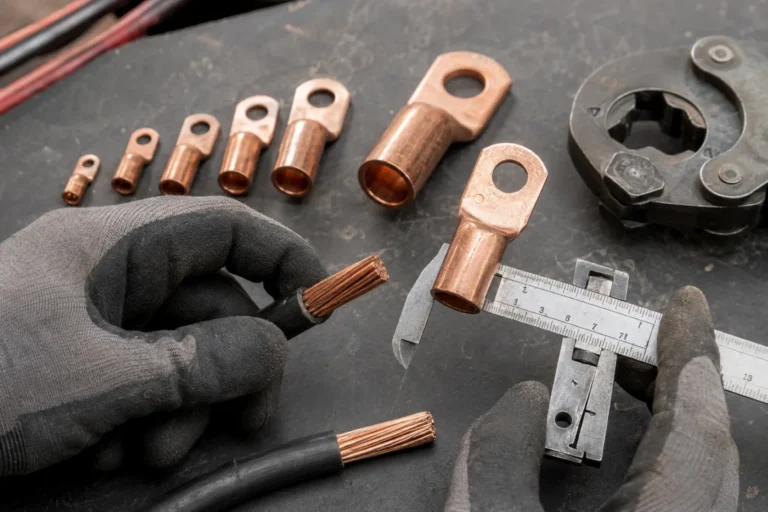
For a combined BOM, list cable cleats separately from cable lugs, terminations, glands and grounding parts, with quantity and specification against each item.
Cable Cleat FAQ
Can I choose a cleat from the conductor size alone?
No. Use the actual cable outside diameter to check the clamping range. Conductor cross-section, voltage level and cable construction are useful context, but they do not establish the overall diameter.
Does an IEC 61914 reference mean every model has the same short-circuit rating?
No. Ask for the documentation applicable to the proposed model and configuration. Review the stated current, duration, cable diameter, formation, spacing and mounting details together.
Can a trefoil test result be used directly for a quad cleat?
Do not assume it can. The supplier should explain the applicability of the evidence and any engineering assessment for the proposed four-cable layout.
Is 316L always better than 316?
No. 316L is the low-carbon variant, with a particular benefit for resistance to intergranular corrosion after welding. Choose the grade from the actual environment and project requirements; neither grade establishes a cleat's mechanical rating.
Can ordinary clamps or cable ties replace a specified cleat?
Only if the proposed assembly meets the required support and restraint duties and the substitution is approved for the project. Similar appearance or a suitable diameter range is not sufficient evidence.
What if the required spacing or fault data is not available?
Send the cable schedule and layout for an initial model review, and identify the missing information. Confirm spacing and fault duty through the project design process before installation or final performance approval.
From formation choice to a catalog model
After choosing the formation, compare the trefoil cable cleat catalog entry with the actual cable diameter and mounting drawing. For other formations, browse cable cleats and clamps and state the required assembly rather than selecting from a photograph.
Use the IEC 61914 specification checklist for the purchase specification. Keep model, drawing revision and applicable report reference together so the quoted assembly can be checked before ordering.
Further Reading
- IEC 61914 Cable Cleat Specification Checklist — a companion guide for preparing the procurement specification.
- IEC 61914:2021 official publication — standard scope and edition information.
- Outokumpu stainless steel grade guidance — 316 and 316L material information.